Aug 2026 — Dec 2026
Optimizing Play of Ticket to Ride
For my senior mathematics capstone project at Bradley University, I chose to analyze the board game Ticket to Ride using Graph Theory, probability, and statistics in an attempt to find an optimal strategy. I created various algorithms, programmed them, and simulated games with various bots to come to my conclusions.
Dr. Michael Lang, Associate Professor of Mathematics at Bradley University was the faculty mentor of this project.
Overview
Ticket to Ride is a board game in which players collect colored train cards to claim railway routes between cities and complete destination tickets for points. Players also earn points for each railway route they claim, based on its length. The player with the most points at the end of the game wins.
This senior project examines Ticket to Ride using graph theory, with the goal of developing optimal play strategies. A Ticket to Ride game board can be represented by a graph in which each city is a vertex and each railway connecting two cities is an edge. Each edge has a weight equal to the number of train cars needed to claim that railway. This project uses the board from the original 2004 edition of Ticket to Ride, which includes cities in the United States and parts of southern Canada. For any editions released up through 2026, there have been no non-cosmetic changes to the Ticket to Ride board.
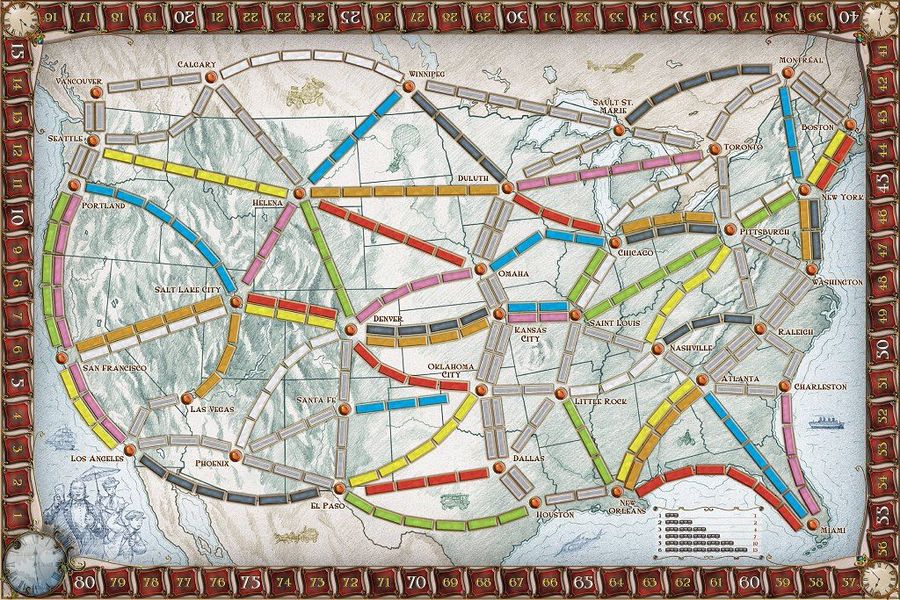
Work In Progress
This project has not yet been completed. More content will be added upon project completion.